
Prologue
There are dates that never end. July 31, 2006 is not a memory: it is an open wound in time. I tried to remember about that night in which a dark mask covered her face. My childhood face to me again. Something changed that night… my mind disappeared. The phone started ringing repeatedly.
My mum took it:
- Do you have a daughter named Laura Torres Caro? Are you the mother?
- What’s happened to my daughter? Is she all right? Is she ok?
- “She has been in a motorcycle accident, Mrs. Caro. Her condition is extremely grave. I’ m very sorry to have to give you this news”
- “Oh my God” where is she exactly?
After hearing the address, my mum took her coat that I like the most and ran to the accident place with my father. When my mother arrived there. She look at me desperately , asking deliberately:
- Is she dead? Laura’ s dead?
- Not dead! Not dead! She’ s in coma after the hard crash.
- In a coma? Mrs. Caro replied.
Latin word coma means “ Sleep of death”
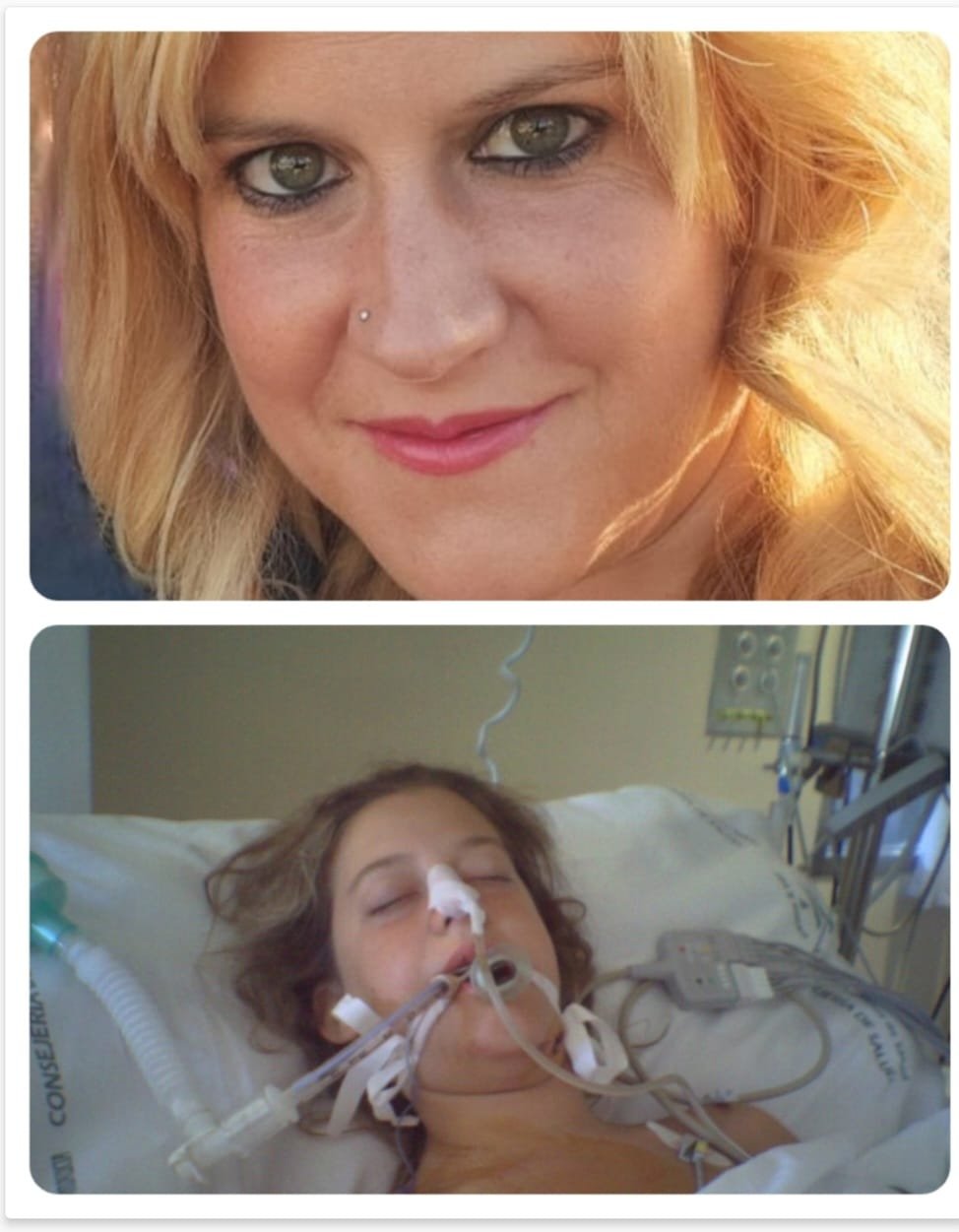
No matter how many years have passed, or how many times I have tried to arrange my memories, that night remains alive somewhere in my body, even when my memory is absent. For almost a month I was in a coma, suspended in time. Since then, my story is not told in a linear way. It fragments. It interrupts. It returns. The clock only keeps marking the same hour. The motorcycle appeared as flashes on her mind repeatedly.
For weeks, months, and many years afterward, I write every line, review every photograph. My thoughts have been coming and going since that night. He is always behind her. From a present that spans two decades of attempts to understand what was broken and what, against all logic, I tried to put back together. Memory loss was not just a symptom: it was a boundary. Before and after. Who I was, what I forgot,
what I had to relearn. And what even today I am still trying to understand. Who am “I,” really?
- She couldn’t stay mad, and he often thinks.
- She had cried and screamed for someone who she didn’t know. And neither did she know the reason for the frequent cries.
- She isn’t crazy.
- He is a passionate lover.
- She sometimes forget her mask.
These books are not born from the accident, but from its consequences. From the passage of time over a body that survived and a mind and brain that never returned to being the same. Between 2006 and 2022 I learned that aftereffects are not always visible, and that some do not manifest immediately. Neurological progression is not an abstract hypothesis: it is a possibility that accompanies every recovered memory, every new forgetting, every signal the body emits without warning.
That is why I return.
I return again and again to that night. I return to look for “her.”
Not with the naivety of believing the past can be changed, but with the need to interrogate it. Though I must be careful not to observe it too closely. Regression is not a fantasy-driven desire, but an attempt to understand a truth I do not know. At what exact point did the thread break? What was lost there that I still cannot name?
Returning is not being there. And on that night, curiously, the protagonist is not always present. There are absences that also tell a story.
This is not only a reconstruction of events, because events do not always survive trauma. It is a search. A dialogue between what I remember, what others told me, and what my body insists on preserving. Writing thus becomes a form of resistance— against forgetting and against the fear of recovering “the past.
Yes, the first book, The Girl from the Mental Stop, was the account of surviving the accidents. The second book, The Girl from the Mental Stop II, is the story of awareness. It is not only about what happened, but about what continues to happen, even when it seems everything is already over. Because some stories do not end with awakening. They begin there.
These books begin where memory fails. And that void tries to say what can still be said. A truth the protagonist longs for—and that someone, obsessed with her past, is trying to make reach her.
Each stop. Each carriage.
Each station… points to something that “she” wants to bury.
He looked at her again in that frankly speculative way that made her feel a little weak and down.
This is where you can see the fictional part of the story.
The real case of Laura pulls you in. Each family member, each friend holds minimal but unsettling details. Each discovery becomes a larger web of secrets and lies. Every sensation that he is getting closer feels like paranoia—yet intuition rarely fails when the truth is near.
The gaps she sometimes has can only be filled by the truth.
The journey became more and more inevitable, even as the darkness surrounding “her” grew more intense.
What follows is not just a story:
it is the desperate attempt to reconstruct what was lost before he finds her again
This is where you can see the fictional part of the story.
The real case of Laura pulls you in. Each family member, each friend holds minimal but unsettling details. Each discovery becomes a larger web of secrets and lies. Every sensation that he is getting closer feels like paranoia—yet intuition rarely fails when the truth is near.
The gaps she sometimes has can only be filled by the truth.
The journey became more and more inevitable, even as the darkness surrounding “her” grew more intense.
What follows is not just a story:
it is the desperate attempt to reconstruct what was lost before he finds her again.